A Group of Art Students Are Painting a Mural on a Wall
| Guernica | |
|---|---|
 | |
| Creative person | Pablo Picasso |
| Year | 1937 |
| Medium | Oil on canvas |
| Movement | Cubism, Surrealism |
| Dimensions | 349.3 cm × 776.6 cm (137.4 in × 305.5 in) |
| Location | Museo Reina Sofía, Madrid, Kingdom of spain |
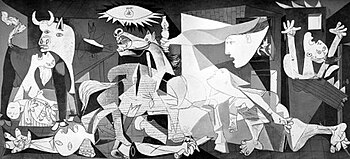
Guernica (Castilian: [ɡeɾˈnika]; Basque: [ɡernika]) is a big 1937 oil painting on sheet by Spanish creative person Pablo Picasso.[1] [ii] It is one of his best-known works, regarded by many fine art critics equally the well-nigh moving and powerful anti-war painting in history.[three] Information technology is exhibited in the Museo Reina Sofía in Madrid.[4]
The grey, blackness, and white painting, which is 3.49 meters (11 ft 5 in) alpine and 7.76 meters (25 ft half-dozen in) across, portrays the suffering wrought by violence and chaos. Prominent in the composition are a gored equus caballus, a balderdash, screaming women, a dead infant, a dismembered soldier, and flames.
Picasso painted Guernica at his home in Paris in response to the 26 Apr 1937 bombing of Guernica, a Basque Country town in northern Spain which was bombed past Nazi Germany and Fascist Italian republic at the request of the Spanish Nationalists. Upon completion, Guernica was exhibited at the Spanish display at the 1937 Paris International Exposition, and and so at other venues effectually the world. The touring exhibition was used to enhance funds for Spanish war relief.[5] The painting presently became famous and widely acclaimed, and it helped bring worldwide attention to the Spanish Ceremonious War.
Committee [edit]
In January 1937, while Pablo Picasso was living in Paris on Rue des Grands Augustins, he was deputed by the Spanish Republican authorities to create a big mural for the Spanish pavilion at the 1937 Paris Globe's Fair. This piece was to help raise awareness of the state of war and raise necessary funds.[six] Picasso, who had last visited Spain in 1934 and would never return, was the Honorary Manager-in-Exile of the Prado Museum.[7]
Picasso worked somewhat dispassionately from January until late April on the project'due south initial sketches, which depicted his perennial theme of an creative person's studio.[1] So, immediately upon hearing reports of the 26 April bombing of Guernica, poet Juan Larrea visited Picasso's abode to urge him to make the bombing his bailiwick.[one] Days later, on 1 May, Picasso read George Steer's bystander account of the attack, which originally had been published in both The Times and The New York Times on 28 April, and abandoned his initial idea. Acting on Larrea's suggestion, Picasso began sketching a series of preliminary drawings for Guernica.[eight]
Historical context [edit]
Bombing of 26 Apr 1937 [edit]
During the Spanish Ceremonious War, the Republican forces were made up of assorted factions such equally communists, socialists, anarchists, and others with differing goals. Yet they were united in their opposition to the Nationalists, led past Full general Francisco Franco, who sought a return to pre-Republican Spain based on law, lodge, and traditional Cosmic values.[9]
Guernica, a town in the province of Biscay in Basque Country, was seen every bit the northern bastion of the Republican resistance move and the middle of Basque culture. This added to its significance every bit a target.[10] Around iv:30 p.1000. on Monday, 26 Apr 1937, warplanes of the Nazi Federal republic of germany Condor Legion, commanded by Colonel Wolfram von Richthofen, bombed Guernica for most ii hours.[11] [10] In his journal for thirty Apr 1937, von Richthofen wrote:
When the outset Junkers squadron arrived, there was smoke already everywhere (from the VB [VB/88] which had attacked with three shipping); nobody would identify the targets of roads, bridge, and suburb, then they just dropped everything right into the middle. The 250s toppled a number of houses and destroyed the h2o mains. The incendiaries at present could spread and become effective. The materials of the houses: tile roofs, wooden porches, and half-timbering resulted in complete annihilation. Most inhabitants were abroad because of a holiday; a majority of the remainder left town immediately at the beginning [of the bombardment]. A small number perished in shelters that were hit."[12]
Other accounts state that since it was Guernica'due south market place day, its inhabitants were congregated in the center of town. When the battery began they were unable to escape because the roads were total of debris and the bridges leading out of town had been destroyed.
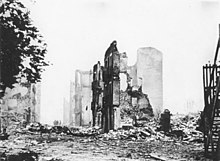
Guernica was a tranquility village 10 kilometers from the front lines, and in-betwixt the front lines and Bilbao, the capital of Bizkaia (Biscay). But any Republican retreat towards Bilbao, or any Nationalist advance towards Bilbao, had to pass through Guernica.[13] Wolfram von Richthofen's war diary entry for 26 Apr 1937 states, "Thou/88 [the Condor Legion bomber strength] was targeted at Guernica in social club to halt and disrupt the Red withdrawal which has to pass through here." Under the German concept of tactical bombing, areas that were routes of transportation and troop movement were considered legitimate armed forces targets. The post-obit day, Richthofen wrote in his war diary, "Guernica burning".[14]
The nearest armed services target of whatsoever consequence was a war product manufacturing plant on Guernica's outskirts, merely it went through the attack unscathed. Thus, the attack was widely condemned as a terror bombing.[xv] [xvi]
Guernica'due south aftermath [edit]
Considering a majority of Guernica's men were away, fighting on behalf of the Republicans, at the time of the bombing the town was populated mostly by women and children.[17] These demographics are reflected in Guernica. As Rudolf Arnheim writes, for Picasso: "The women and children brand Guernica the image of innocent, caught humanity victimized. Also, women and children take ofttimes been presented by Picasso as the very perfection of mankind. An assault on women and children is, in Picasso'southward view, directed at the core of mankind."[10]
The Times announcer George Steer, a Basque and Republican sympathizer, propelled this effect onto the international scene and brought it to Pablo Picasso's attending. Steer'southward eyewitness account was published on 28 Apr in both The Times and The New York Times, and on the 29th it appeared in L'Humanité, a French Communist daily. Steer wrote:
Guernica, the most aboriginal boondocks of the Basques and the centre of their cultural tradition, was completely destroyed yesterday afternoon by insurgent air raiders. The bombardment of this open boondocks far behind the lines occupied precisely three hours and a quarter, during which a powerful armada of aeroplanes consisting of three types of German types, Junkers and Heinkel bombers, did non end unloading on the town bombs weighing from 1,000 lbs. downwards and, it is calculated, more than three,000 two-pounder aluminium incendiary projectiles. The fighters, meanwhile, plunged depression from above the middle of the town to machinegun those of the civilian population who had taken refuge in the fields."[17]
Picasso lived in Paris during the German occupation during World State of war Two. A widely repeated story is that a German officer one time asked him, upon seeing a photo of Guernica in Picasso's apartment, "Did you exercise that?", and Picasso responded, "No, y'all did."[18]
Creation [edit]
On 11 May the canvas is ready, and immediately the composition is laid down as a linear structure that covers the whole surface. Work on the landscape is accompanied past more thirty studies for the details. The crude plan exists from the beginning, but it takes 3 weeks before the picture receives its final course. The bull's caput remains where it was first put, simply the trunk is turned effectually to the left. On 20 May the horse lifts its caput. The trunk of the soldier stretched on the flooring from left to right changes position on 4 June, and then head and hand take on their finished shape.
At the final moment the creative person makes one decisive adjustment: the drama first took identify on a street with burning houses in the groundwork. Now, suddenly, the diagonals are accentuated, and thereby space becomes ambiguous, unreal, inside and outside at the same time. The lamp is hung over the horse's head, looking on the dreadful scene similar a broad-open up middle. The construction is strengthened, the mural more strongly integrated in Sert'south architecture. Into the mitt of the dying soldier, side by side to the broken sword, Picasso puts the little flower of hope.
The picture was finished about mid-June. Hundreds of thousands of exhibition-goers wandered by, looking on information technology equally a wall ornament, but every bit Europe wandered by the human drama of the Spanish Ceremonious War—as if it were a thing concerning only the inhabitants of the peninsula. They disregarded the alarm, did not empathize that republic on the whole continent was at stake.
W. J. H. B. Sandberg, Daedalus, 1960 [xix]
Guernica was painted using a matte house paint specially formulated at Picasso'due south request to take the least possible gloss.[one] American creative person John Ferren assisted him in preparing the monumental canvass,[twenty] and photographer Dora Maar, who had been working with Picasso since mid-1936 photographing his studio and teaching him the technique of cameraless photography,[21] documented its creation. Apart from their documentary and publicity value, Maar's photographs "helped Picasso to eschew color and give the work the blackness-and-white immediacy of a photo", according to fine art historian John Richardson.[ane]
Picasso, who rarely allowed strangers into his studio to watch him work, admitted influential visitors to notice his progress on Guernica, assertive that the publicity would aid the antifascist crusade.[ane] As his piece of work on the mural progressed, Picasso explained: "The Castilian struggle is the fight of reaction confronting the people, against freedom. My whole life as an artist has been nothing more than than a continuous struggle against reaction and the death of art. How could anybody think for a moment that I could be in understanding with reaction and death? ... In the panel on which I am working, which I shall call Guernica, and in all my contempo works of fine art, I clearly express my abhorrence of the war machine caste which has sunk Spain in an ocean of pain and death."[22]
Picasso worked on the painting for 35 days, and finished it on iv June 1937.[1]
Composition [edit]

The scene occurs within a room where, on the left, a wide-eyed balderdash with a tail suggesting rise fume stands over a grieving woman holding a dead child in her artillery. A horse falls in agony in the center of the room, with a big gaping hole in its side, as if it had but been run through by a spear or javelin. The equus caballus appears to be wearing chain post armor, decorated with vertical tally marks arranged in rows.
A expressionless and dismembered soldier lies under the horse. The hand of his severed right arm grasps a shattered sword, from which a blossom grows, and the open palm of his left hand contains a stigma, a symbol of martyrdom derived from the stigmata of Christ. A bare calorie-free bulb in the shape of an all-seeing heart blazes over the suffering horse's head.
To the horse's upper right the head and extended correct arm of a frightened female person figure appears to take floated into the room through a window, and she witnesses the scene. In her right mitt she carries a flame-lit lamp, and holds it near the bare seedling. From the right, beneath the witness, an awe-struck adult female staggers towards the center, looking into the blazing light bulb with a bare stare.
Daggers that suggest screaming have replaced the tongues of the horse, the bull, and the grieving woman. To the balderdash'due south correct a dove appears on a cracked wall through which brilliant calorie-free from the exterior shines.
On the far right a fourth woman, her arms raised in terror, her wide open mouth and thrown back caput echoing the grieving adult female'southward, is entrapped by fire from above and below. Her right paw suggests the shape of an airplane.
A dark wall with an open door defines the right side of the room.
Ii "hidden" images formed by the equus caballus appear in Guernica:[23]
- The horses nostrils and upper teeth can as well be seen as a human skull facing left and slightly downwards.
- A balderdash appears to gore the horse from underneath. The bull'due south caput is formed mainly by the horse'south entire front leg which has the human knee on the ground. The leg'due south genu cap forms the head'southward nose. A horn appears within the horse'southward breast. The bull's tail forms the image of a flame with smoke ascension from information technology, seemingly appearing in a window created by the lighter shade of gray surrounding it.
Symbolism and interpretations [edit]
Interpretations of Guernica vary widely and contradict one another. This extends, for example, to the mural'south two ascendant elements: the bull and the horse. Art historian Patricia Failing said, "The bull and the equus caballus are important characters in Spanish culture. Picasso himself certainly used these characters to play many different roles over time. This has made the task of interpreting the specific meaning of the bull and the equus caballus very tough. Their relationship is a kind of ballet that was conceived in a variety of ways throughout Picasso's career."
When pressed to explain the elements in Guernica, Picasso said,
...this bull is a balderdash and this horse is a horse... If y'all give a pregnant to certain things in my paintings it may exist very true, only it is not my idea to requite this meaning. What ideas and conclusions you have got I obtained too, but instinctively, unconsciously. I brand the painting for the painting. I paint the objects for what they are.[24]
In The Dream and Prevarication of Franco, a serial of narrative sketches Picasso besides created for the World'south Off-white, Franco is depicted as a monster that first devours his own horse and afterward does battle with an angry bull. Work on these illustrations began before the bombing of Guernica, and four additional panels were added, three of which relate straight to the Guernica mural.
According to scholar Beverly Ray, the following list of interpretations reflects the full general consensus of historians: "The shape and posture of the bodies express protest"; "Picasso uses black, white, and gray pigment to ready a somber mood and express pain and chaos"; "flaming buildings and crumbling walls not but express the destruction of Guernica, but reflect the subversive power of ceremonious state of war"; "the paper impress used in the painting reflects how Picasso learned of the massacre"; "The calorie-free bulb in the painting represents the sun"; and "The broken sword near the bottom of the painting symbolizes the defeat of the people at the hand of their tormentors".[11]
Alejandro Escalona said, "The chaos unfolding seems to happen in closed quarters provoking an intense feeling of oppression. At that place is no way out of the nightmarish cityscape. The absenteeism of color makes the violent scene developing right before your eyes even more horrifying. The blacks, whites, and grays startle you—particularly considering you are used to see war images circulate alive and in loftier-definition right to your living room."[25]
In drawing attention to a number of preliminary studies, the so-called primary projection,[26] that bear witness an atelier installation incorporating the key triangular shape which reappears in the final version of Guernica, Becht-Jördens and Wehmeier interpret the painting as a self-referential limerick in the tradition of atelier paintings such as Las Meninas past Diego Velázquez. In his chef d'oeuvre, Picasso seems to be trying to define his office and his power as an creative person in the face of political power and violence. Just far from beingness a mere political painting, Guernica should exist seen as Picasso's comment on what art can actually contribute towards the self-assertion that liberates every man and protects the individual against overwhelming forces such every bit political crime, war, and death.[27]
Exhibition [edit]
1937 Paris International Exhibition [edit]

Guernica was unveiled and initially exhibited in July 1937 at the Spanish Pavilion at the Paris International Exposition,[28] where Nazi Federal republic of germany and Stalinist Russia had huge pavilions. The Pavilion, which was financed by the Spanish Republican government at the time of ceremonious state of war, was built to exhibit the Castilian government'south struggle for being contrary to the Exposition's technology theme. The Pavilion'due south entrance presented an enormous photographic mural of Republican soldiers accompanied past the slogan:
- We are fighting for the essential unity of Spain.
- We are fighting for the integrity of Spanish soil.
- We are fighting for the independence of our land and for the right of the Spanish people to determine their ain destiny.
The display of Guernica was accompanied by a poem by Paul Éluard, and the pavilion displayed The Reaper past Joan Miró and Mercury Fountain by Alexander Calder, both of whom were sympathetic to the Republican cause.
At Guernica 's Paris Exhibition unveiling it garnered lilliputian attending. The public's reaction to the painting was mixed.[29] Max Aub, one of the officials in charge of the Spanish pavilion, was compelled to defend the work confronting a group of Spanish officials who objected to the mural's modernist style and sought to supervene upon information technology with a more traditional painting that was also commissioned for the exhibition, Madrid 1937 (Black Aeroplanes) past Horacio Ferrer de Morgado.[i] Some Marxist groups criticized Picasso's painting as lacking in political commitment, and faulted it for not offering a vision of a better time to come.[thirty] In contrast, Morgado's painting was a great success with Castilian Communists and with the public.[1] The art critic Clement Greenberg was also disquisitional of Guernica,[31] and in a later essay he termed the painting "jerky" and "too compressed for its size", and compared it unfavorably to the "magnificently lyrical" The Charnel Firm (1944–1948), a afterward antiwar painting by Picasso.[32]
Amidst the painting's admirers were art critic Jean Cassou and poet José Bergamín, both of whom praised the painting as quintessentially Castilian.[33] Michel Leiris perceived in Guernica a foreshadowing: "On a black and white canvas that depicts ancient tragedy ... Picasso also writes our alphabetic character of doom: all that nosotros dear is going to be lost..."[34]
European bout [edit]
Guernica, for which Picasso was paid 200,000 francs for his costs past the Spanish Republican government, was one of the few major paintings that Picasso did not sell directly to his exclusive contracted art dealer and friend, Paul Rosenberg.[35] However, after its exhibition Rosenberg organised a iv-man extravaganza Scandinavian tour of 118 works by Picasso, Matisse, Braque, and Henri Laurens. The tour'due south main attraction was Guernica.
From January to April 1938 the tour visited Oslo, Copenhagen, Stockholm, and Göteborg. Starting in late September Guernica was exhibited in London'south Whitechapel Fine art Gallery. This stop was organized past Sir Roland Penrose with Labour Party leader Clement Attlee, and the painting arrived in London on 30 September, the aforementioned day the Munich Understanding was signed by the leaders of the United Kingdom, France, Italy, and Germany. It then travelled to Leeds, Liverpool, and, in early 1939, Manchester. There, Manchester Foodship For Spain, a group of artists and activists engaged in sending aid to the people of Espana, exhibited the painting in the HE Nunn & Co Ford car showroom for 2 weeks.[36] Guernica then returned briefly to France.
American tour [edit]
After Francisco Franco's victory in Kingdom of spain, Guernica was sent to the U.s.a. to enhance funds and support for Spanish refugees. Information technology was start shown at the Valentine Gallery in New York City in May 1939. The San Francisco Museum of Art (subsequently renamed the San Francisco Museum of Modernistic Art) gave the work its first museum advent in the United States from 27 August to 19 September 1939. New York's Museum of Modern Fine art (MoMA) then mounted an exhibition from 15 November until vii January 1940, entitled: Picasso: forty Years of His Art. The exhibition, which was organized by MoMA's director Alfred H. Barr in collaboration with the Art Institute of Chicago, contained 344 works, including Guernica and its studies.[37]
At Picasso's request the safekeeping of Guernica was then entrusted to the Museum of Modern Art, and it was his expressed desire that the painting should not exist delivered to Spain until liberty and republic had been established in the country.[7] Between 1939 and 1952, Guernica traveled extensively in the U.s.a.. Between 1941 and 1942, it was exhibited at Harvard University'due south Fogg Museum twice.[38] [39]
Between 1953 and 1956 information technology was shown in Brazil, then at the start Picasso retrospective in Milan, Italy, and and so in numerous other major European cities earlier returning to MoMA for a retrospective celebrating Picasso'due south 75th altogether. It so went to Chicago and Philadelphia. By this time, concern for the land of the painting resulted in a determination to keep it in one place: a room on MoMA's tertiary floor, where it was accompanied by several of Picasso's preliminary studies and some of Dora Maar's photographs of the work in progress. The studies and photos were ofttimes loaned for other exhibitions, but until 1981, Guernica itself remained at MoMA.[7]
During the Vietnam War, the room containing the painting became the site of occasional anti-war vigils. These were usually peaceful and uneventful, but on 28 February 1974, Tony Shafrazi—ostensibly protesting Second Lieutenant William Calley'southward petition for habeas corpus post-obit his indictment and sentencing for the murder of 109 Vietnamese civilians during the My Lai massacre—defaced the painting with red spray paint, painting the words "KILL LIES ALL". The pigment was removed with relative ease from the varnished surface.[forty]
Institution in Spain [edit]
Every bit early equally 1968, Franco had expressed an interest in having Guernica come to Kingdom of spain.[7] Notwithstanding, Picasso refused to permit this until the Castilian people once again enjoyed a republic. He later added other conditions, such as the restoration of "public liberties and democratic institutions". Picasso died in 1973. Franco, ten years Picasso's inferior, died two years subsequently, in 1975. Subsequently Franco's death, Espana was transformed into a democratic constitutional monarchy, ratified by a new constitution in 1978. However, MoMA was reluctant to requite up one of its greatest treasures and argued that a monarchy did not stand for the democracy that had been stipulated in Picasso's volition every bit a status for the painting's delivery. Nether great pressure from a number of observers, MoMA finally ceded the painting to Spain in 1981. The Spanish historian Javier Tusell was one of the negotiators.
Upon its arrival in Spain in September 1981,[41] it was first displayed backside bomb-and bullet-proof glass screens[42] at the Casón del Buen Retiro in Madrid in fourth dimension to gloat the centenary of Picasso's birth, 25 Oct.[41] The exhibition was visited past almost a 1000000 people in the starting time twelvemonth.[43] Since that fourth dimension there has never been any attempted vandalism or other security threat to the painting.
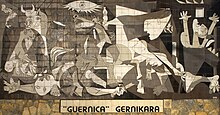
A tiled wall in Gernika claims "Guernica" Gernikara, "The Guernica (painting) to Gernika."
In 1992, the painting was moved from the Museo del Prado to a purpose-built gallery at the Museo Nacional Centro de Arte Reina Sofía, both in Madrid, along with well-nigh two dozen preparatory works.[44] This action was controversial in Spain, since Picasso's will stated that the painting should exist displayed at the Prado. Still, the motion was role of a transfer of all of the Prado's collections of art after the early 19th century to other nearby buildings in the city for reasons of space; the Reina Sofía, which houses the capital'south national drove of 20th-century art, was the natural place to move it to. At the Reina Sofía, the painting has roughly the same protection as whatsoever other work.[45]
Basque nationalists take advocated that the picture should be brought to the Basque Country,[46] especially after the building of the Guggenheim Bilbao Museum. Officials at the Reina Sofía claim[47] that the canvas is now thought to be too frail to move. Fifty-fifty the staff of the Guggenheim do not see a permanent transfer of the painting as possible, although the Basque authorities continues to support the possibility of a temporary exhibition in Bilbao.[45]
Tapestry at the Un [edit]

A full-size tapestry copy of Picasso's Guernica, by Jacqueline de la Baume Dürrbach,[48] hangs at the Headquarters of the United nations in New York City at the archway to the Security Council room.[49] It is less monochromatic than the original and uses several shades of brown.
The Guernica tapestry was first displayed from 1985 to 2009, and returned in 2015. Originally deputed in 1955 by Nelson Rockefeller, since Picasso refused to sell him the original,[50] the tapestry was placed on loan to the United Nations by the Rockefeller manor in 1985.[51]
On 5 February 2003 a large blue curtain was placed to cover over the work at the UN, then that information technology would not exist visible in the groundwork during press conferences by Colin Powell and John Negroponte equally they were arguing in favor of war on Republic of iraq.[52] On the post-obit day, UN officials claimed that the drapery was placed in that location at the asking of television news crews, who had complained that the wild lines and screaming figures fabricated for a bad properties, and that a horse'south hindquarters appeared simply to a higher place the faces of any speakers. Some diplomats, nevertheless, in talks with journalists claimed that the Bush assistants pressured Un officials to cover the tapestry, rather than accept it in the background while Powell or other U.s.a. diplomats argued for state of war on Republic of iraq.[five] In a critique of the covering, columnist Alejandro Escalona hypothesized that Guernica 's "unappealing ménage of mutilated bodies and distorted faces proved to be too strong for articulating to the globe why the U.s.a. was going to war in Iraq", while referring to the work as "an inconvenient masterpiece".[25]
On 17 March 2009, Deputy Spokesperson for the Secretary-Full general Marie Okabe announced that the Guernica tapestry had been moved to a gallery in London in advance of extensive renovations at Un Headquarters. The Guernica tapestry was the showcase slice for the grand reopening of the Whitechapel Gallery. Information technology was located in the 'Guernica room' which was originally part of the old Whitechapel Library.[53] In 2012 the tapestry was on loan from the Rockefeller family unit to the San Antonio Museum of Art in San Antonio, Texas.[54] Information technology was returned to the UN by March 2015.[55] Nelson A. Rockefeller Jr., the owner of the tapestry, took it back in February 2021.[56] In February 2022, it was returned to the wall outside the UN Security Council.[49]
Significance and legacy [edit]
"Guernica is to painting what Beethoven'south 9th Symphony is to music: a cultural icon that speaks to flesh not only against war merely likewise of promise and peace. It is a reference when speaking about genocide from El Salvador to Bosnia."
Alejandro Escalona, on the 75th ceremony of the painting's creation[25]
During the 1970s, Guernica was a symbol for Spaniards of both the finish of the Franco regime following Franco's expiry, and of Basque nationalism. The Basque left has repeatedly used imagery from the moving picture. An instance is the organisation Etxerat, which uses a reversed image of the lamp every bit its symbol.[57] Guernica has since become a universal and powerful symbol warning humanity against the suffering and destruction of war.[25] There are no obvious references to the specific attack, making its message universal and timeless.[25]
Art historian and curator Due west. J. H. B. Sandberg argued in Daedalus in 1960 that Picasso pioneered a "new language" combining expressionistic and cubist techniques in Guernica. Sandberg wrote that Guernica conveyed an "expressionistic bulletin" in its focus on the inhumanity of the air raid, while using "the language of cubism". For Sandberg, the work'south defining cubist features included its use of diagonals, which rendered the painting'due south setting "cryptic, unreal, inside and outside at the same time".[xix] In 2016, the British art critic Jonathan Jones called the painting a "Cubist apocalypse" and stated that Picasso "was trying to evidence the truth so viscerally and permanently that it could outstare the daily lies of the age of dictators".[58] [59]
Works inspired past Guernica include Religion Ringgold's 1967 painting The American People Series #twenty: Die; Goshka Macuga'due south The Nature of the Beast (2009–2010), which used the Whitechapel-hosted Un Guernica tapestry; The Keiskamma Guernicas (2010–2017); and Erica Luckert's theatrical production of Guernica (2011–2012).[60] [61] Fine art and pattern historian Dr Nicola Ashmore curated an exhibition, Guernica Remakings, at the University of Brighton galleries from 29 July 2017 to 23 August 2017.[60]
See also [edit]
- Guernica, 1950 film directed by Alain Resnais and Robert Hessens
- The 2018 tv set series Genius features Picasso'due south life and piece of work, including Guernica
- The Weeping Woman, 1937 Picasso painting
- Guernica, 1937 sculpture by René Iché
- The Charnel House, 1944-45 Picasso painting
- Massacre in Korea, 1951 Picasso painting[62]
- Dove, 1949 Picasso lithograph
- 1980 BBC series 100 Cracking Paintings, 1980
References and sources [edit]
- References
- ^ a b c d e f g h i Richardson (2016)
- ^ Picasso, Pablo. Guernica. Museo Reina Sofía. (Retrieved 2017-09-07.)
- ^ "Pablo Picasso". Biography.com.
- ^ Forrest Brown. "ten most famous paintings in the world". CNN . Retrieved 13 Apr 2021.
- ^ a b Cohen (2003).
- ^ "Picasso and 'Guernica': Exploring the Anti-War Symbolism of This Famous Painting". My Modern Met. 31 December 2021. Retrieved 8 Jan 2022.
- ^ a b c d Timeline, part of a series of web pages on Guernica in PBS'due south Treasures of the World series. Accessed 16 July 2006.
- ^ Preston, Paul (2012) The Destruction of Guernica. HarperCollins At Google Books. Retrieved xviii July 2013.
- ^ Barton (2004).
- ^ a b c Arhheim, (1973) p. ???
- ^ a b Ray (2006), 168–171.
- ^ Quoted in Oppler (1988), p. 166.
- ^ Beevor (2006), 231
- ^ Beevor (2006), 233.
- ^ Saul, Toby (8 May 2018). "The horrible inspiration behind one of Picasso's great works". nationalgeographic.com. Retrieved 21 May 2019.
- ^ Overy, Richard (2013). The Bombing State of war: Europe, 1939-1945. Penguin UK. p. ix. ISBN 0141927828.
- ^ a b Preston (2007). 12–19.
- ^ Tom Lubbock (27 March 2013). "Review: Guernica by Gijs van Hensbergen | Books". The Guardian . Retrieved 20 April 2013.
- ^ a b Sandberg, W.J.H.B (1960). "Picasso's "Guernica"". Daedalus . Retrieved 19 March 2021.
- ^ John Ferren biography, guggenheim.org. Retrieved 17 November 2020.
- ^ Fluegel (1980), p. 308.
- ^ Tóibín (2006).
- ^ https://spokenvision.com/the-7-hidden-symbols-in-picassos-guernica/ 7 hidden symbols in the painting
- ^ ...questions of meaning, part of a series of web pages on Guernica in PBS's Treasures of the World series. Accessed 16 July 2006.
- ^ a b c d e Escalona, Alejandro. 75 years of Picasso's Guernica: An Inconvenient Masterpiece, The Huffington Post, 23 May 2012.
- ^ Werner Spies: Guernica und dice Weltausstellung von 1937. In: Id.: Kontinent Picasso. Ausgewählte Aufsätze, Munich 1988, Southward. 63–99.
- ^ Meet Becht-Jördens (2003)
- ^ Martin (2002)
- ^ Witham (2013), p. 175.
- ^ Greeley, Robin A. (2006). Surrealism and the Spanish Civil State of war. New Haven: Yale University Press. p. 241. ISBN 0300112955
- ^ Witham (2013), p. 176
- ^ Greenberg (1993), p. 236.
- ^ Martin (2003), p. 128.
- ^ Martin (2003), p. 129.
- ^ Van Hensbergen, Gijs (2005) Guernica p. 83 Bloomsbury Publishing At Google Books. Retrieved iv November 2013
- ^ Youngs, Ian (15 Feb 2012). "BBC News – Picasso's Guernica in a car showroom". Bbc.co.britain. Retrieved 20 April 2013.
- ^ Fluegel (1980), p. 350
- ^ Cuno, James B., ed. (1996). Harvard'due south art museums: 100 years of collecting. Cambridge: Harvard University Museums. p. 38. ISBN0-8109-3427-two. OCLC 33948167.
- ^ "Picasso's "Guernica" borrowed past Fogg Art Museum for Two Weeks". The Harvard Crimson. 1 October 1941. Retrieved 22 January 2021.
{{cite web}}: CS1 maint: url-status (link) - ^ Hoberman 2004
- ^ a b (in Spanish) "30 años del "Guernica" en España" Universidad Nacional de Educación a Distancia (UNED). Retrieved xviii July 2013.
- ^ Van Hensbergen, Gijs (2005) Guernica p. 305. Bloomsbury Publishing At Google Books. Retrieved xviii July 2013.
- ^ (in Castilian) "Un millón de personas ha visto el 'Guernica' en el Casón del Buen Retiro" El País. Retrieved xviii July 2013.
- ^ The Casón del Buen Retiro: History Museo del Prado. Retrieved 18 July 2013.
- ^ a b Writer interview on Russell Martin'due south Picasso's War site. Accessed 16 July 2006.
- ^ Ibarretxe reclama 'para siempre' el 'Guernica', El Mundo, 29 June 2007.
- ^ El Patronato del Reina Sofía rechaza la cesión temporal del 'Guernica' al Gobierno vasco, El Mundo, 22 June 2006.
- ^ "In praise of ... Guernica". The Guardian. 26 March 2009. Retrieved 12 July 2017.
- ^ a b Falk, Pamela (5 February 2022). "Picasso's anti-war tapestry Guernica returns to the U.N."
- ^ Conrad, Peter. "A scream we can't ignore", The Guardian, x March 2004.
- ^ Campbell (2009), 29.
- ^ Kennedy (2009).
- ^ Hensbergen (2009).
- ^ Fine art, San Antonio Museum of. "San Antonio Museum of Art - Domicile". Samuseum.org . Retrieved 22 December 2017.
- ^ Remnick, David (2015). "Today'due south Woman", The New Yorker, 23 March 2015.
- ^ "Iconic tapestry of Picasso's 'Guernica' is gone from the U.N." NBC News. AP. 26 February 2021. Retrieved 26 February 2021.
- ^ "Etxerat". Etxerat. Retrieved 17 March 2016.
- ^ As Aleppo burns in this age of lies, Picasso'southward Guernica nonetheless screams the truth virtually war
- ^ Lxxx years later, the Nazi state of war crime in Guernica still matters - The grim anniversary of the bombing is a reminder of humanity'due south continuing chapters for evil
- ^ a b "136959 Guernica Remakings 2019". Southbank Centre. Archived from the original on 14 August 2020. Retrieved 26 August 2020.
- ^ Smee, Sebastian (12 February 2020). "American carnage". The Washington Post. Archived from the original on 22 March 2022. Retrieved 24 April 2022.
- ^ https://www.bbc.com/culture/article/20190620-picasso-the-ultimate-painter-of-war BBC: Picasso, the ultimate painter of war?
- Sources
- Arnheim, Rudolf. (1973). The Genesis of a Painting: Picasso'southward Guernica. London: University of California Press. ISBN 978-0-520-25007-9
- Barton, Simon. (2004). A History of Spain. New York: Palgrave Macmillan.
- Becht-Jördens, Gereon: Picassos Guernica als kunsttheoretisches Programm. In: Becht-Jördens, Gereon and Wehmeier, (In German) Peter Thou.: Picasso und die christliche Ikonographie. Mutterbeziehung und künstlerische Position. Dietrich Reimer, Berlin 2003, South. 209–237 ISBN 3-496-01272-two
- Becraft, Melvin East. Picasso's Guernica – Images inside Images third Edition PDF download
- Beevor, Antony. (2006) The Battle for Spain: The Spanish Ceremonious War 1936–1939. London: Weidenfeld & Nicolson. ISBN 978-0-297-84832-5
- Edgeless, Anthony. (1969) Picasso'south Guernica. Oxford: Oxford Academy Printing. ISBN 0-nineteen-500135-four
- Bonazzoli, Francesca, and Michele Robecchi. (2014) "Pablo Picasso: Guernica", in Mona Lisa to Marge: How the World's Greatest Artworks Entered Pop Culture. New York: Prestel. ISBN 978-379134877-3
- Campbell, Peter (2009). "At the New Whitechapel" London Review of Books 31(8), 30 April 2009.
- Cohen, David. (2003) Hidden Treasures: What'southward And so Controversial Well-nigh Picasso'due south Guernica?, Slate, 6 February 2003. Accessed 16 July 2006.
- Fluegel, Jane. (1980) "Chronology" in Rubin (1980) Pablo Picasso: A Retrospective.
- Francesconi, Elizabeth. (2006) "A Expect Inside Picasso'southward War Images", soapbox: An Online Journal by the students of Southern Methodist University, Spring 2006.
- Granell, Eugenio Fernándes, Picasso's Guernica: the end of a Castilian era (Ann Arbor, Mich. : UMI Research Printing, 1981) ISBN 0-8357-1206-0, ISBN 978-0-8357-1206-4
- Greenberg, Clement (1993). The Collected Essays and Criticism; Volume 4: Modernism with a Vengeance, 1957–1969. University of Chicago Press. ISBN 0226306240
- Harris, Marker and Becraft, Melvin Due east. Picasso's Surreptitious Guernica
- Hensbergen, Gijs van. (2004) Guernica: The Biography of a Twentieth-Century Icon. London: Bloomsbury. ISBN 978-1-58234-124-8
- Hensbergen, Gijs van. (2009) "Piecing together Guernica". BBC News Magazine: 7 Apr 2009. Accessed: fourteen Baronial 2009.
- Hoberman, J. "Popular and Circumstance". The Nation, 13 December 2004, 22–26.
- Kennedy, Maev. (2009) "Picasso tapestry of Guernica heads to UK", London: The Guardian, 26 January 2009. Accessed: 14 August 2009.
- Mallen, Enrique On-Line Picasso Project – OPP.37:001. [ dead link ]
- Martin, Russell. (2003). Picasso's War. London: Simon & Schuster Great britain. ISBN 978-0-7434-7863-two
- Martin, Russell. (2002) Picasso's War: The Devastation of Guernica and the Masterpiece that Inverse the Globe (2002). On-line excerpts link.
- Oppler, Ellen C. (ed). (1988). Picasso's Guernica (Norton Critical Studies in art History). New York: W. W. Norton. ISBN 0-393-95456-0
- PBS On-line supplement to "Treasures of the Globe" series, "Guernica: Testimony to War" with Guernica timeline.
- Pisik, Betsy. (2003) "The Picasso Cover-Up". The Washington Times, 3 February 2003. Re-published at CommonDreams.org. Accessed: xiv August 2009
- Preston, Paul. (2007) "George Steer and Guernica". History Today 57 (2007): 12–19.
- Ray, Beverly. (2006) "Analyzing Political Art to Get at Historical Fact: Guernica and the Spanish Civil War". The Social Studies 97 (2006): 168–171.
- Richardson, John (2016) "A Different Guernica". The New York Review of Books, 12 May 2016, 63 (8): 4–six.
- Rubin, William, ed. (1980) Pablo Picasso: A Retrospective. New York: The Museum of Modernistic Art. ISBN 0-87070-519-nine
- Thomas, Gordon & Morgan-Witts, Max. (1975). The Mean solar day Guernica Died. London: Hodder & Stoughton. ISBN 0-340-19043-4
- Tóibín, Colm. (2006) "The art of war", London: The Guardian, 29 April 2006. Accessed: 14 August 2009.
- Witham, Larry (2013). Picasso and the chess actor: Pablo Picasso, Marcel Duchamp, and the battle for the soul of modern art. Hanover; London : Academy Press of New England. ISBN 9781611682533
External links [edit]
 | Wikimedia Commons has media related to Guernica. |
- Rethinking Guernica – Museo Reina Sofía site with more 2000 documents referenced and a gigapixel image of the painting.
- Fine art Opposes Injustice! – Picasso'south Guernica: For Life by Dorothy Koppelman
- 3-D Guernica, YouTube
- Guardian: Picasso's Guernica Battle Lives On 26 April 2007
- Guernica – Zoomable version.
- Picasso'southward "Surreptitious" Guernica
- Socialist Worker: Guernica: Shock and Awe in Paint Archived 24 September 2015 at the Wayback Car 24 Apr 2007
- The New Yorker: Spanish Lessons, Picasso in Madrid by Peter Schjeldahl, nineteen June 2006
- X-ray Shows Picasso's Guernica Painting has Suffered a lot simply is non in Danger Associated Press, 23 July 2008
- Guernica Remakings Website collating and analysing the activeness of remaking versions the iconic painting.
cunninghamsquaques.blogspot.com
Source: https://en.wikipedia.org/wiki/Guernica_(Picasso)
0 Response to "A Group of Art Students Are Painting a Mural on a Wall"
Post a Comment